Research Interests

News & Updates

Publications

Filter:
Thumbnail for Beta-OPSD

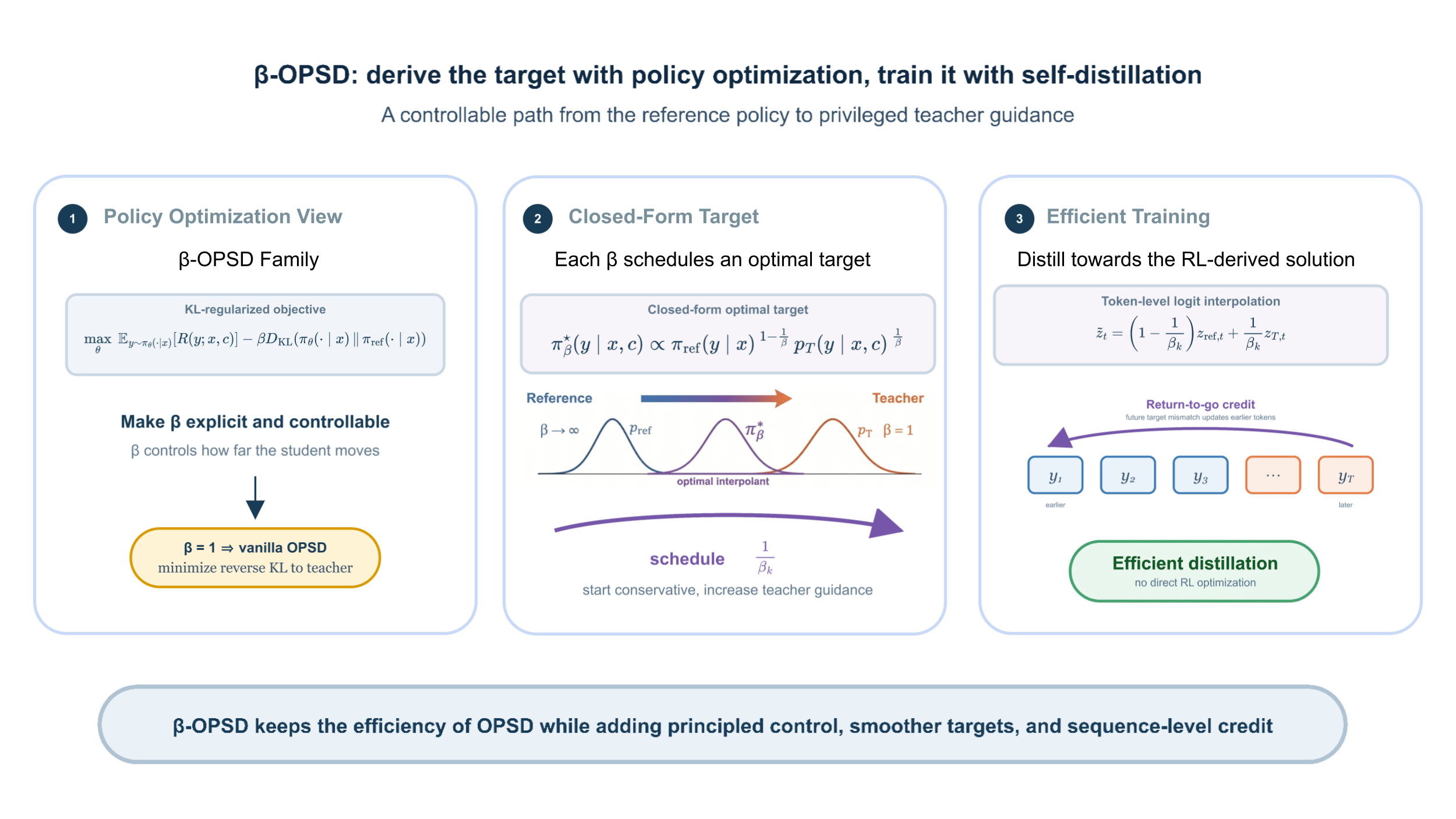
β-OPSD: Deriving with Policy Optimization, Training with Self-Distillation

Jiawei Xu*, Minghui Liu*, Juzheng Zhang, Tom Goldstein, Furong Huang

arXiv, 2026

  • Reasoning
  • Reinforcement Learning
  • Efficiency
Abstract

On-policy self-distillation (OPSD) is a promising approach to improve reasoning language models, but it remains brittle in practice: making it work reliably often requires substantial engineering effort. We identify a structural source of this difficulty: vanilla OPSD is precisely the β = 1 member of a broader policy-optimization family, where β weights the KL penalty anchoring the student to a reference policy. This equivalence turns β from an implicit value fixed at one into a controllable regularization parameter, yielding a more general formulation that trades off proximity to a reference policy against privileged teacher guidance. We introduce β-OPSD and derive its optimal policy as a geometric interpolation between the reference policy and the privileged teacher. Directly optimizing this objective with reinforcement learning, however, would be costly and high-variance. Rather than optimize the RL objective directly, we turn its closed-form solution into a distillation target. Each value of β selects a target along the reference-to-teacher path, which we implement efficiently by mixing their token-level logits. In this way, inexpensive distillation approximates the solution of expensive policy optimization. Return-to-go credit assignment further aligns token updates with the sequence-level objective while retaining the simplicity of OPSD. Experiments on mathematical reasoning benchmarks show that β-OPSD consistently outperforms vanilla OPSD, improving optimization stability and downstream reasoning performance. Our results provide a principled route from self-distillation to policy optimization and back—without sacrificing the efficiency that makes OPSD practical.

Thumbnail for VeriGate

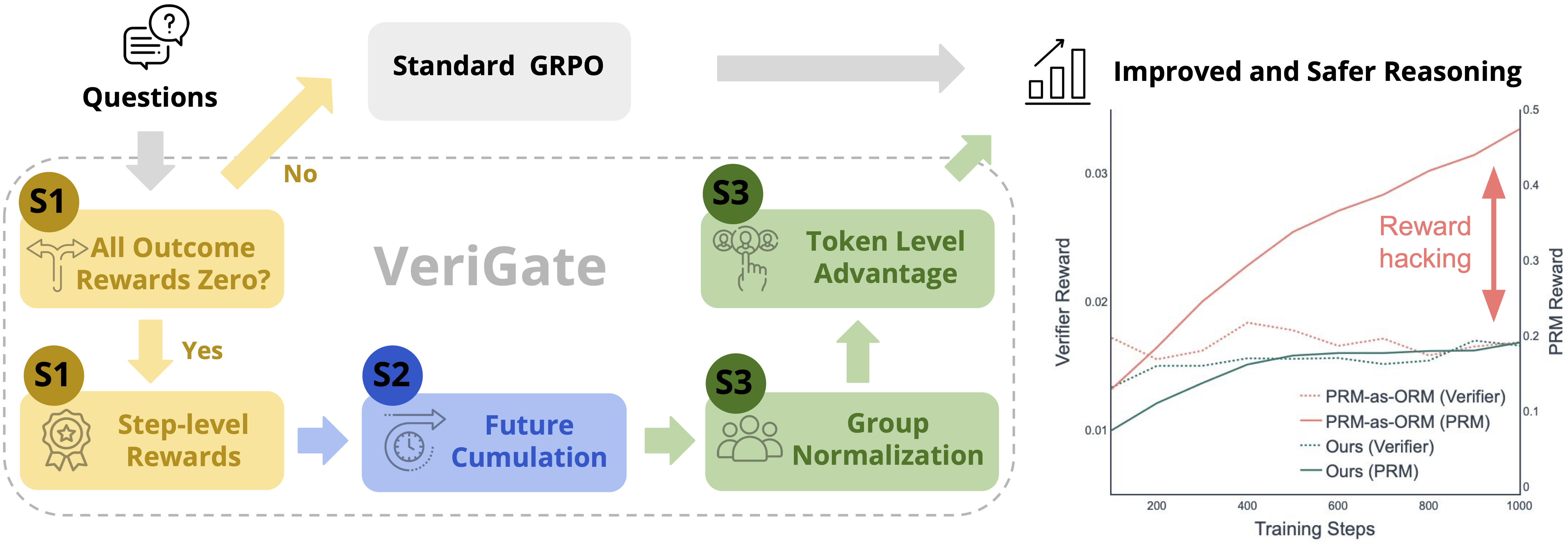
VeriGate: Verifier-Gated Step-Level Supervision for GRPO

Aakriti Agrawal*, Minghui Liu*, Furong Huang

Preprint under peer review at NeurIPS, 2026

  • Reasoning
  • Reinforcement Learning
Abstract

Group Relative Policy Optimization (GRPO) is an effective recipe for training reasoning models with verifier-based outcome rewards, but its supervision is sparse: when all sampled trajectories for a prompt receive the same verifier reward, the group-relative advantage collapses to zero and learning stalls. Outcome-only rewards also provide no step-level credit assignment, limiting exploration and making it harder to learn robust reasoning. We present VeriGate (Verifier-Gated Step-Level GRPO), a verifier-gated extension of GRPO that addresses these limitations with three design choices. First, VeriGate keeps the verifier in charge whenever verifier rewards induce a meaningful preference among sampled trajectories, and uses process supervision only when verifier rewards are degenerate. Second, instead of collapsing Process Reward Model (PRM) step scores into a single trajectory reward, VeriGate converts them into future-cumulated rewards to assign continuation-aware credit. Third, VeriGate transforms these rewards into group-normalized token-level advantages, restoring informative gradients and fine-grained credit assignment while remaining less susceptible to reward hacking than methods that optimize aggregated PRM scores. Empirically, training on MATH with 1.5B and 7B Qwen2.5-Instruct models and evaluating on six reasoning benchmarks, VeriGate improves average accuracy by about 20% and 12% for 1.5B and 7B models respectively, substantially reduces zero-gradient failures, decreases reward-hacking behavior, and improves reasoning quality relative to outcome-only GRPO and PRM-as-outcome baselines.

Thumbnail for Scheduling Thoughts

Scheduling Thoughts: Learning the Order of Thought in Diffusion Language Models

Jiawei Xu, Minghui Liu, Aakriti Agrawal, Yifan Chen, Furong Huang

ICML (Poster), 2026

  • Diffusion
  • Reasoning
Abstract

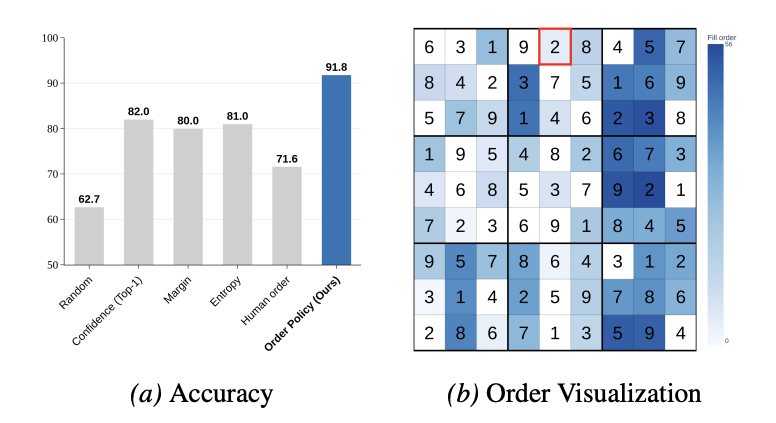
Masked diffusion language models decode by iteratively unmasking tokens, where the unmasking order defines an “order of thought” that strongly influences generation quality yet is typically chosen heuristically. We derive a tractable upper bound on the sequential decoding mismatch, measured by the Kullback–Leibler divergence and expressed in terms of the model’s pathwise log-likelihood, with tightness under sufficient model expressivity. This bound induces a dense self-aware reward over ordered trajectories, casting order selection as a principled policy optimization problem with a frozen denoiser. We instantiate this idea as Self-Aware Scheduling (SAS), which learns a lightweight order policy using Group Relative Policy Optimization and applies seamlessly to both any-order and semi-autoregressive decoding. On Sudoku with 1B MDM, SAS improves puzzle accuracy from 82.0% (best heuristic schedule) to 91.8%, and reaches 97.5% with second-stage fine-tuning along learned trajectories. On mathematical reasoning with LLaDA-8B, SAS improves pass@1 on GSM8K from 64% to 76% and on MBPP from 39.5% to 41%, consistently matching or exceeding heuristic schedules across generation lengths and block sizes.

Thumbnail for SoundnessBench

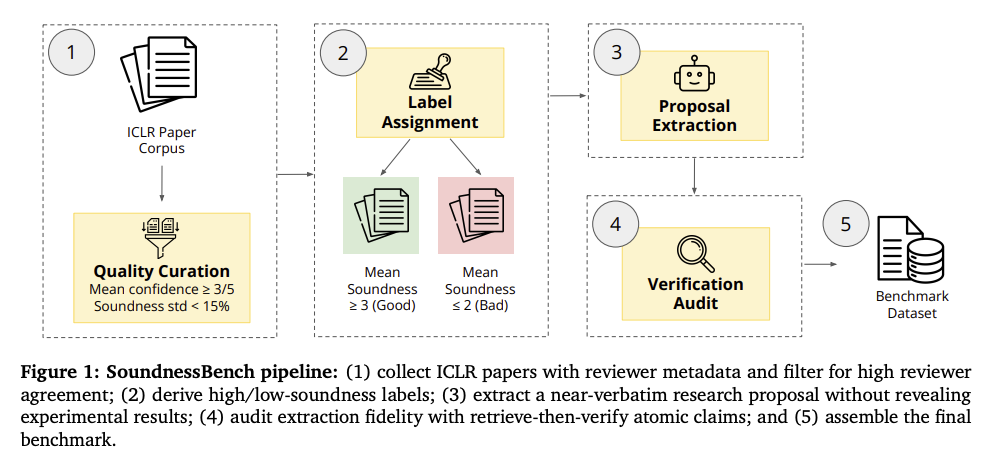
SoundnessBench: Can Your AI Scientist Really Tell Good Research Ideas from Bad Ones?

Sy-Tuyen Ho, Minghui Liu, Huy Nghiem, Furong Huang

Preprint under peer review at COLM, 2026

  • Evaluation
  • Reasoning
Abstract

Autonomous AI research agents aim to accelerate scientific discovery by automating the research pipeline, from hypothesis generation to peer review. However, existing benchmarks rarely test a fundamental bottleneck: whether Large Language Models can judge the methodological viability of a research idea before expending time and computational resources. We introduce SoundnessBench, a curated benchmark of 1,099 machine-learning research proposals reconstructed from ICLR submissions, labeled with reviewer soundness sub-scores, and audited against source papers. SoundnessBench should be interpreted as a benchmark for recoverable proposal-stage soundness rather than exact prediction of full-paper review outcomes. Across 12 frontier LLMs, we find a pervasive optimism bias: under standard prompting, models frequently rate low-soundness proposals as sound, while aggressive prompting largely shifts errors from false positives to false negatives. Additional controls for public-corpus contamination, paper-identifying phrases, surface features, and human audit quality suggest that this behavior is not explained by a single confounder. Our results indicate that current LLMs are not yet reliable as standalone first-gate evaluators for scientific rigor.

Thumbnail for Agentic Critical Training

Agentic Critical Training

Weize Liu, Minghui Liu, Sy-Tuyen Ho, Souradip Chakraborty, Xiyao Wang, Furong Huang

Preprint under peer review at COLM 2026

  • Reasoning
  • Agent
  • Reinforcement Learning
Abstract

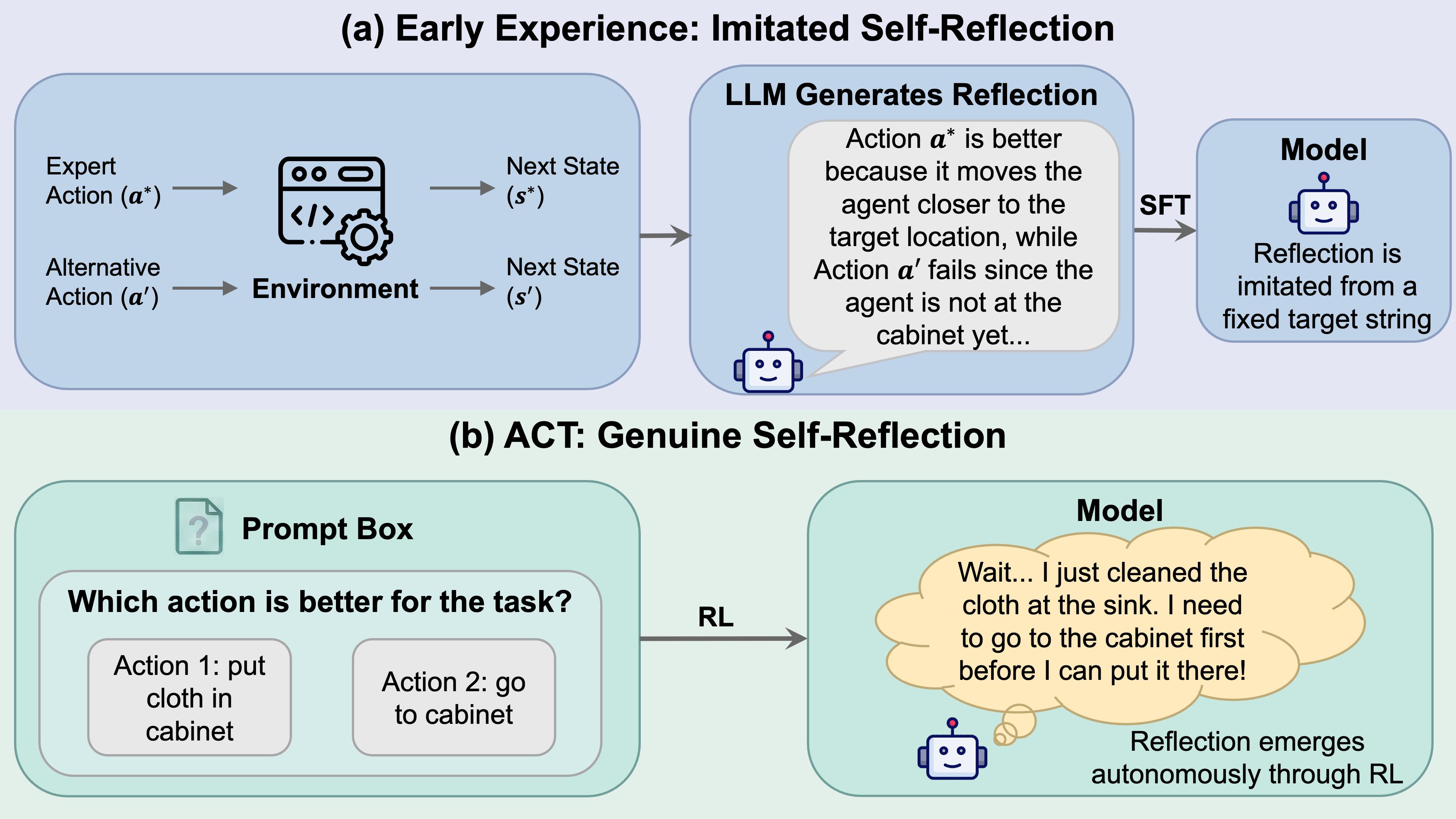
Training large language models (LLMs) as autonomous agents often begins with imitation learning, but it only teaches agents what to do without understanding why: agents never contrast successful actions against suboptimal alternatives and thus lack awareness of action quality. Recent approaches attempt to address this by introducing self-reflection supervision derived from contrasts between expert and alternative actions. However, the training paradigm fundamentally remains imitation learning: the model imitates pre-constructed reflection text rather than learning to reason autonomously. We propose Agentic Critical Training (ACT), a reinforcement learning paradigm that trains agents to identify the better action among alternatives. By rewarding whether the model’s judgment is correct, ACT drives the model to autonomously develop reasoning about action quality, producing genuine self-reflection rather than imitating it. Across three challenging agent benchmarks, ACT consistently improves agent performance when combined with different post-training methods. It achieves an average improvement of 5.07 points over imitation learning and 4.62 points over reinforcement learning. Compared to approaches that inject reflection capability through knowledge distillation, ACT also demonstrates clear advantages, yielding an average improvement of 2.42 points. Moreover, ACT enables strong out-of-distribution generalization on agentic benchmarks and improves performance on general reasoning benchmarks without any reasoning-specific training data, highlighting the value of our method. These results suggest that ACT is a promising path toward developing more reflective and capable LLM agents.

Thumbnail for Ladders of Thought

Ladders of Thought: A Self-Evolving Curriculum of Progressively Simplified Reasoning Traces

Minghui Liu, Thomas Magelinski, Dehao Yuan, Qi Yu, Furong Huang

arXiv, 2025

  • LLM Reasoning
Abstract

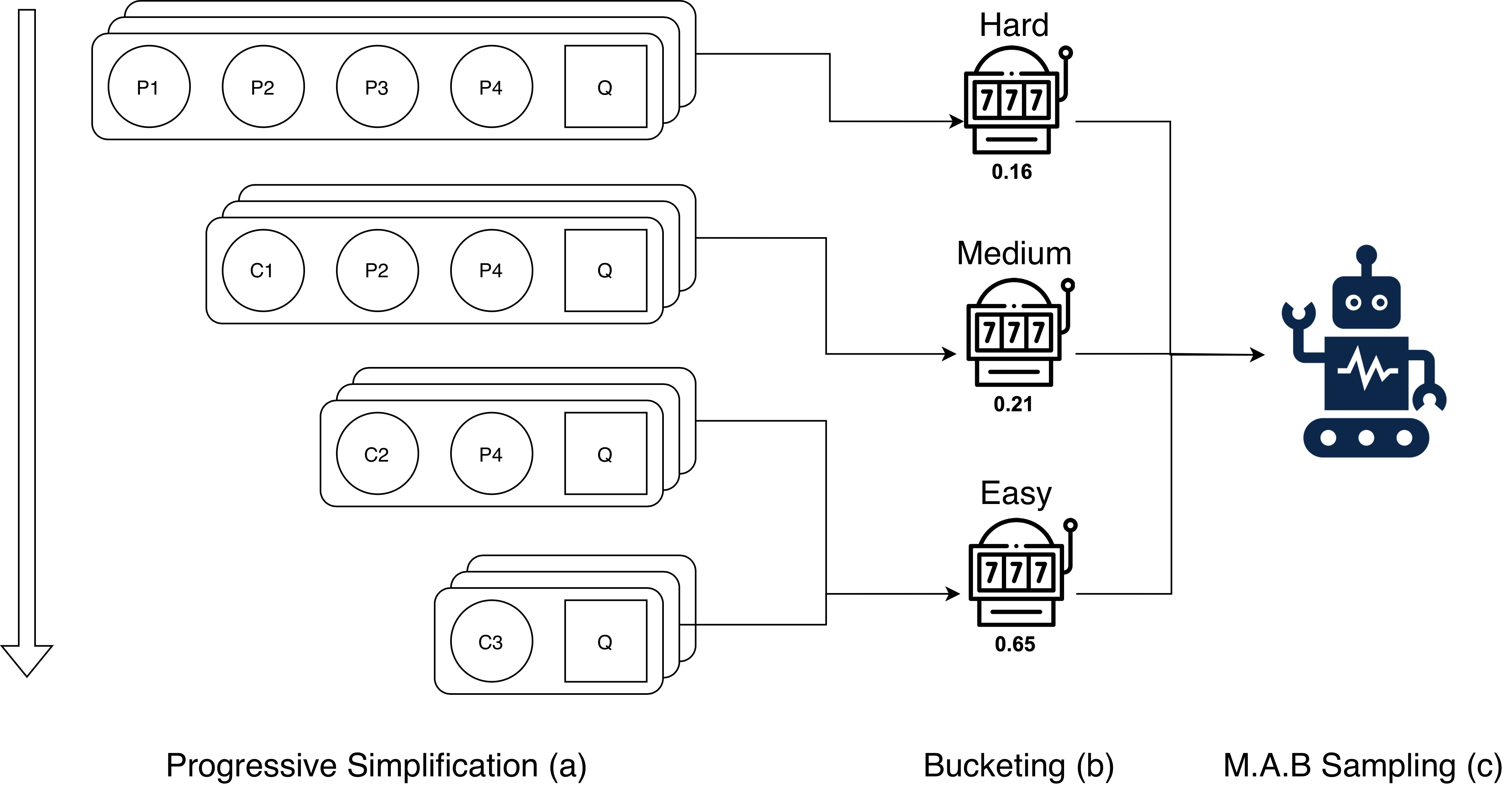
Large language models (LLMs) excel at reasoning when scaled to hundreds of billions of parameters, but small- and mid-scale models remain brittle reasoners even with knowledge distillation (KD). We present Ladders-of-Thought (LoT), a framework that improves reasoning by combining progressive question rewrites with a self-evolving curriculum. LoT automatically generates semantically faithful but easier variants of reasoning problems, organizes them into difficulty buckets using step-based measures, and employs a self-evolving bandit scheduler to allocate training adaptively. Evaluated on two reasoning domains, math and multi-hop reasoning, across OPT-1.3B/2.7B and Pythia-1.4B/2.8B, LoT consistently improves over KD. It delivers large gains on arithmetic tasks (e.g., +32 percentage points on AddSub, +25pp on SVAMP), +2–8pp improvements on in-domain test splits, and strong though dataset-dependent benefits on multi-hop reasoning (e.g., +16pp on QASC, +25pp on StrategyQA). LoT also converges faster than staged curricula, highlighting the value of adaptive progression. These results show that progressive rewrites coupled with adaptive curricula provide a simple yet effective recipe for strengthening reasoning in smaller LLMs.

Thumbnail for MORSE-500

MORSE-500: A Programmatically Controllable Video Benchmark to Stress-Test Multimodal Reasoning

Zikui Cai, Andrew Wang, Anirudh Satheesh, Ankit Nakhawa, Hyunwoo Jae, Keenan Powell, Minghui Liu, Neel Jay, Sungbin Oh, Xiyao Wang, Yongyuan Liang, Tom Goldstein, Furong Huang

arXiv, 2025

  • Multimodal Reasoning
Abstract

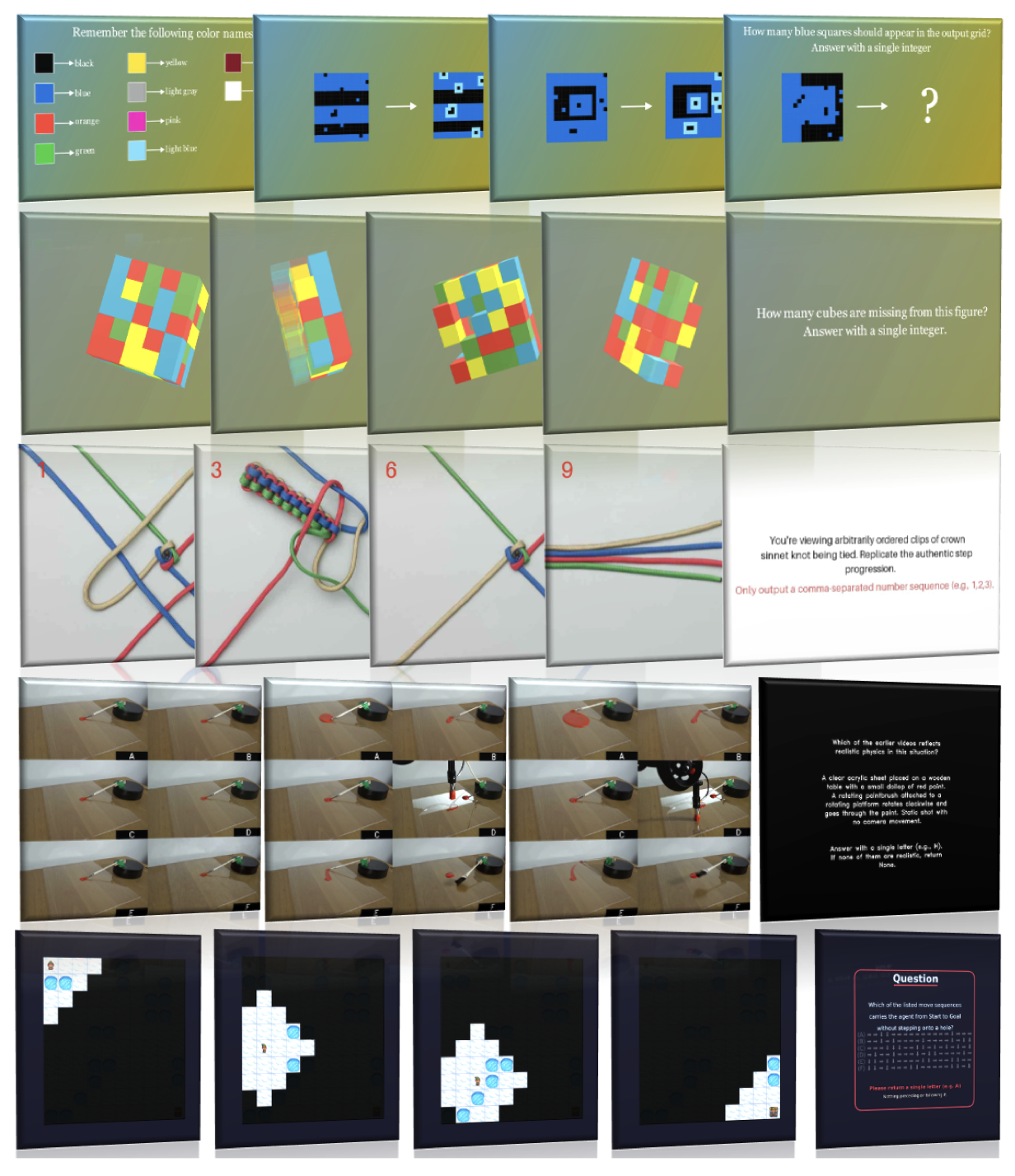
Despite rapid advances in vision-language models (VLMs), current benchmarks for multimodal reasoning fall short in three key dimensions. First, they overwhelmingly rely on static images, failing to capture the temporal complexity of real-world environments. Second, they narrowly focus on mathematical problem-solving, neglecting the broader spectrum of reasoning skills—including abstract, physical, planning, spatial, and temporal capabilities—required for robust multimodal intelligence. Third, many benchmarks quickly saturate, offering limited headroom for diagnosing failure modes or measuring continued progress. We introduce MORSE-500 (Multimodal Reasoning Stress-test Environment), a video benchmark composed of 500 fully scripted clips with embedded questions spanning six complementary reasoning categories. Each instance is programmatically generated using deterministic Python scripts (via Manim, Matplotlib, MoviePy), generative video models, and curated real footage. This script-driven design allows fine-grained control over visual complexity, distractor density, and temporal dynamics—enabling difficulty to be scaled systematically as models improve. Unlike static benchmarks that become obsolete once saturated, MORSE-500 is built to evolve: its controllable generation pipeline supports the creation of arbitrarily challenging new instances, making it ideally suited for stress-testing next-generation models. Initial experiments with state-of-the-art systems—including various Gemini 2.5 Pro and OpenAI o3, which represent the strongest available at the time, alongside strong open-source models—reveal substantial performance gaps across all categories, with particularly large deficits in abstract and planning tasks. We release the full dataset, generation scripts, and evaluation harness to support transparent, reproducible, and forward-looking multimodal reasoning research.

Thumbnail for Hold Onto That Thought

Hold Onto That Thought: Assessing KV Cache Compression On Reasoning

Minghui Liu, Tahseen Rabbani, Aadi Palnitkar, Kyle Rui Sang, Hyunwoo Jae, Dixi Yao, Shayan Shabihi, Fuheng Zhao, Tian Li, Ce Zhang, Kunpeng Zhang, Furong Huang

NeurIPS Efficient Reasoning Workshop, 2025

  • Efficient LLM
Abstract

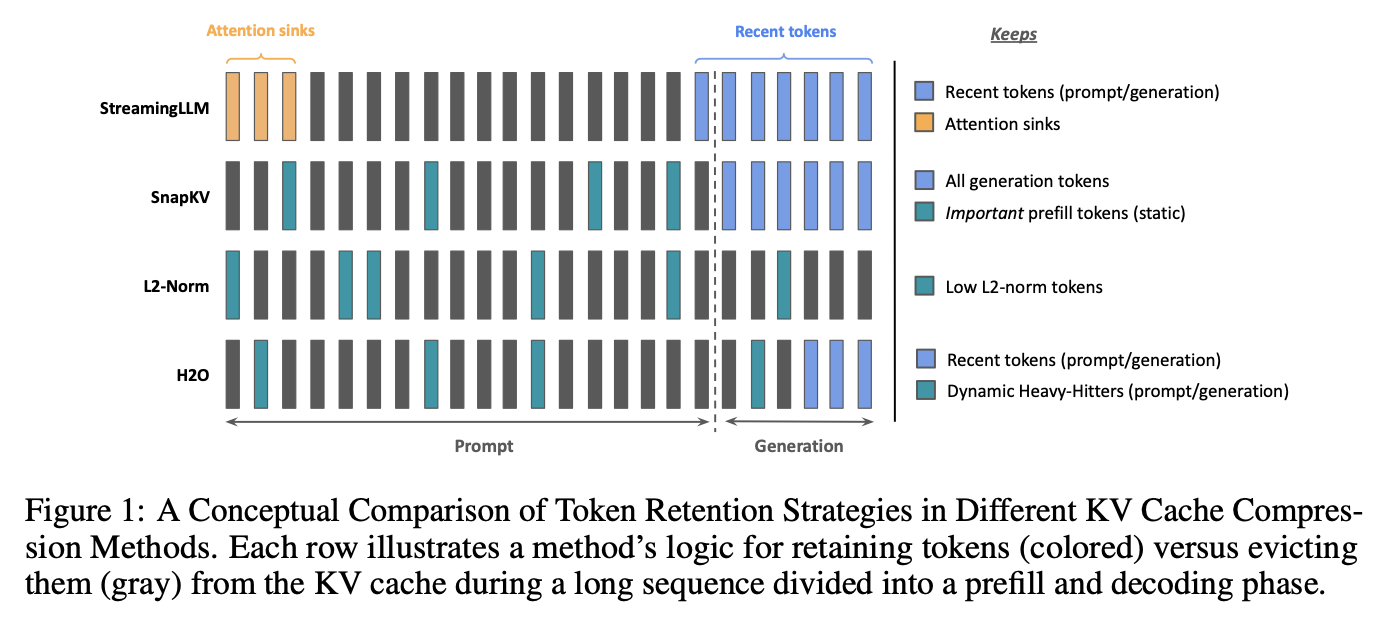
Large language models (LLMs) have demonstrated remarkable performance on long-context tasks, but are often bottlenecked by memory constraints. Namely, the KV cache, which is used to significantly speed up attention computations, grows linearly with context length. A suite of compression algorithms has been introduced to alleviate cache growth by evicting unimportant tokens. However, several popular strategies are targeted towards the prefill phase, i.e., processing long prompt context, and their performance is rarely assessed on reasoning tasks requiring long decoding. In particular, short but complex prompts, such as those in benchmarks like GSM8K and MATH500, often benefit from multi-step reasoning and self-reflection, resulting in thinking sequences thousands of tokens long. In this work, we benchmark the performance of several popular compression strategies on long-reasoning tasks. For the non-reasoning Llama-3.1-8B-Instruct, we determine that no singular strategy fits all, and that performance is heavily influenced by dataset type. However, we discover that H2O and our decoding-enabled variant of SnapKV are dominant strategies for reasoning models, indicating the utility of heavy-hitter tracking for reasoning traces. We also find that eviction strategies at low budgets can produce longer reasoning traces, revealing a tradeoff between cache size and inference costs.

Thumbnail for Learning Normal Flow

Learning Normal Flow Directly From Events

Dehao Yuan, Levi Burner, Jiayi Wu, Minghui Liu, Jingxi Chen, Yiannis Aloimonos, Cornelia Fermüller

ICCV, 2025

  • Computer Vision
Abstract

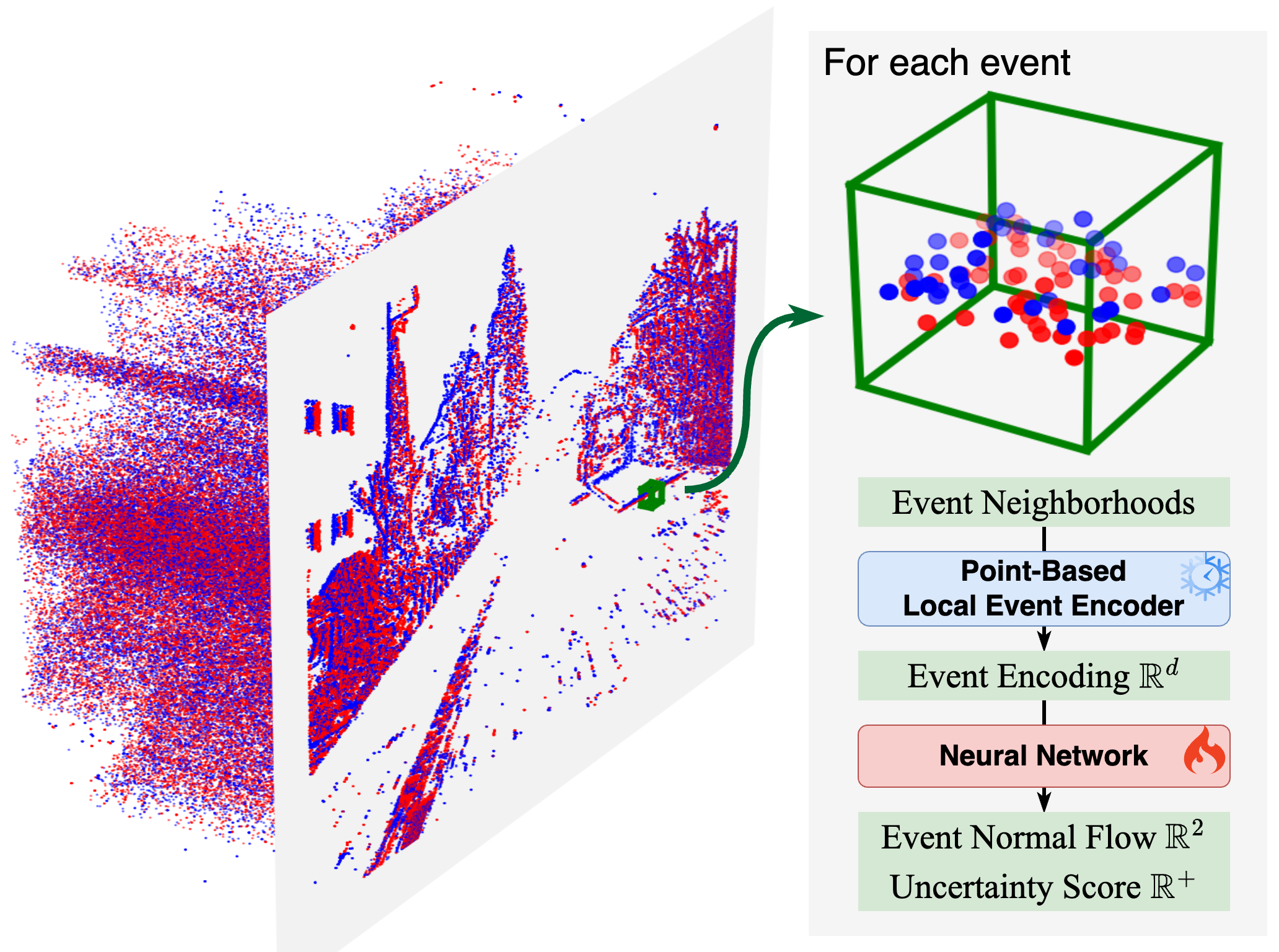
Event-based motion field estimation is an important task. However, current optical flow methods face challenges: learning-based approaches, often frame-based and relying on CNNs, lack cross-domain transferability, while model-based methods, though more robust, are less accurate. To address the limitations of optical flow estimation, recent works have focused on normal flow, which can be more reliably measured in regions with limited texture or strong edges. However, existing normal flow estimators are predominantly model-based and suffer from high errors. In this paper, we propose a novel supervised point-based method for normal flow estimation that overcomes the limitations of existing event learning-based approaches. Using a local point cloud encoder, our method directly estimates per-event normal flow from raw events, offering multiple unique advantages: 1) It produces temporally and spatially sharp predictions. 2) It supports more diverse data augmentation, such as random rotation, to improve robustness across various domains. 3) It naturally supports uncertainty quantification via ensemble inference, which benefits downstream tasks. 4) It enables training and inference on undistorted data in normalized camera coordinates, improving transferability across cameras. Extensive experiments demonstrate our method achieves better and more consistent performance than state-of-the-art methods when transferred across different datasets. Leveraging this transferability, we train our model on the union of datasets and release it for public use. Finally, we introduce an egomotion solver based on a maximum-margin problem that uses normal flow and IMU to achieve strong performance in challenging scenarios.

Thumbnail for HashEvict

HashEvict: A Pre-Attention KV Cache Eviction Strategy using Locality-Sensitive Hashing

Minghui Liu*, Tahseen Rabbani*, Tony O'Halloran, Ananth Sankaralingam, Mary-Anne Hartley, Furong Huang, Cornelia Fermüller, Yiannis Aloimonos

arXiv, 2024

  • Efficient LLM
Abstract

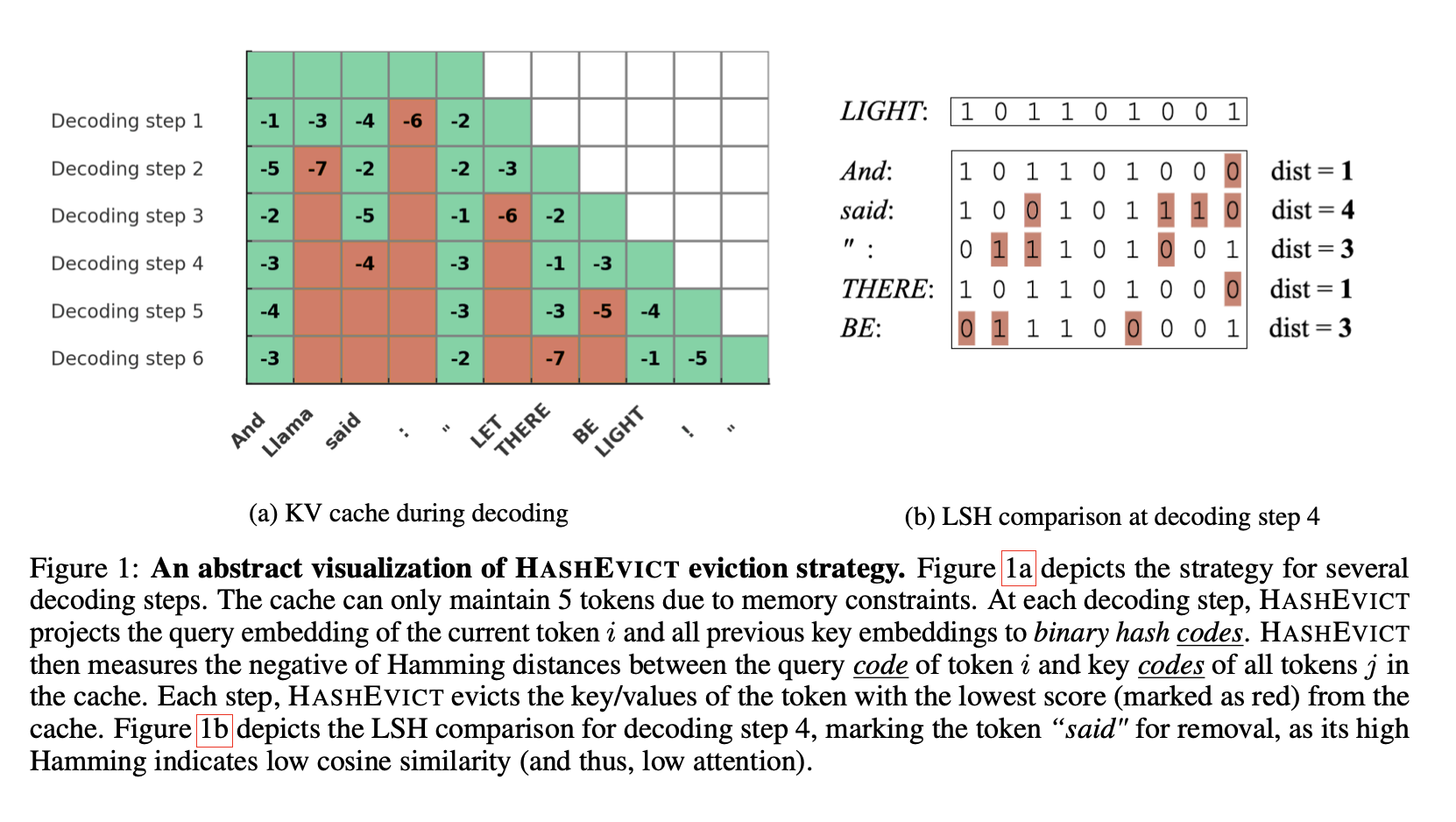
Transformer-based large language models (LLMs) use the key-value (KV) cache to significantly accelerate inference by storing the key and value embeddings of past tokens. However, this cache consumes significant GPU memory. In this work, we introduce HashEvict, an algorithm that uses locality-sensitive hashing (LSH) to compress the KV cache. HashEvict quickly locates tokens in the cache that are cosine dissimilar to the current query token. This is achieved by computing the Hamming distance between binarized Gaussian projections of the current token query and cached token keys, with a projection length much smaller than the embedding dimension. We maintain a lightweight binary structure in GPU memory to facilitate these calculations. Unlike existing compression strategies that compute attention to determine token retention, HashEvict makes these decisions pre-attention, thereby reducing computational costs. Additionally, HashEvict is dynamic—at every decoding step, the key and value of the current token replace the embeddings of a token expected to produce the lowest attention score. We demonstrate that HashEvict can compress the KV cache by 30%–70% while maintaining high performance across reasoning, multiple-choice, long-context retrieval and summarization tasks.

Academic Services